Monday, 29 August 2022

Day 3. A Night and Day I'd Rather Forget

After dinner last night I didn't feel right, eventually I was sick, but I also had diarrhea.  This cycle of nausea, vomiting and diarrhea lasted the whole night, leaving me without sleep and completely drained in the morning. My roomie Christopher found me on the floor in the bathroom in the morning, I found the cool tile floor a relief. He got me some Coke, which is my usual Coke trick to give some relief and sugar for energy.  

I wanted to ride, so gingerly put on my kit and set off with the others.  I figured once sitting down on the bike that would be easy enough.  But the heat was intense and after only a few km I didn't feel right and was overcome by a wall of heat. I don't know why I decided at that moment to pull over, but when I did, I promptly fainted. Steve was there with me and tried to stop me falling over, but I ended up in a heap with the bike on top of me.  Steve and Cary pulled it off me and sat me down in the shade and soon a crowd had gathered. When Charlie arrived an electrolyte mix was prepared in an attempt to get my fluids up. Steve said the seriousness of the situation was ably demonstrated by the fact that he has not a single picture of the event.

My bike is loaded on the back of the Hilux support vehicle and the rest of the day was spent in the passenger seat while the others rode 350km. 
The first part of the ride was in the seering heat at lower altitudes and then turned into a deliscious ribbon of mostly fast pristine asphalt that wound its way through and up in to the mountains.  
I was trying to sleep unsuccessfully so missed much of the scenery, but soon we reach Afghanistan! Well we saw it in the distance across the wild, fast flowing, Panj river. 
We followed the river and Afghanistan for about 50km, the Tajik side with the lovely asphalt, while on the Afghan side it was a dirt track complete with a few mopeds carrying their loads. The Taliban are famous for using mopeds to carry any load including missile launchers (but we didn't see any of those).
At one point there was a direction sign to Afghanistan and a road leading to a bridge over the river and an Taliban military base on the other side of the river. 
We stopped several times during the day, but I was so out of it, it was all a blur. So, sorry this blog entry is bereft of details.  

Our hotel for the night is on the side of a smaller river feeding the Panj and we can hear it flowing, which is quite therapeutic. We can also still see Afghanistan in the distance.  
I had some solid food at dinner so hopefully I'll be in better shape to ride tomorrow.

A day of which I wish I had better memories. One interesting snippet is that my Garmin watch's "body battery" indicator was at its lowest % all day. Its never done that. I don't think I've ever been so ill. 

The day before 
Today
The day after

Sunday, 28 August 2022

Day 2. Shakedown ride into the Fann Mountains

First day of riding and we're introduced to our bikes, Steve going through the rental document with a fine toothed comb crossing out sections that have no relevance or are just unreasonable, such as charging for each scratch. Andre our guide assures us it is just a standard text and that he will not be unreasonable about minor damage caused by wear and tear. 
The bikes are DR650SEs, updated and lighter versions of Biker Dom's own 1991 DR650RSE. They have higher kms on the speedo, but are generally in very good condition. Let's hope they stay that way as some of us have reputations for falling off! 
Boris the chicken takes his place and we're off, and we leave the surprisingly not that busy roads of the capital city Dushanbe. 
Speed limits seem rather optional to the traffic around us, but we try to keep up to stay safe. After a short while we leave the city.

A nice asphalt road takes us north west and we start to climb. That usually means bends and it didn't disappoint, flowing nicely. As we reach steep sided valleys we have to negotiate a series of tunnels culminating in an unlit 5km dark dungeon. When you first enter it takes your eyes a few terrifying moments to adjust and after a that you soon begin to appreciate how bad the headlights are on DR650SEs, there are no lights in this tunnel and so the terror continues for 5km. The headlights of oncoming vehicles give some relief as they light your path, but they're soon gone. The dark walls seem to soak up any photons emitted by your headlight, making it really difficult to see the walls, the road surface and to judge speed - you dare not even look down at the speedo as you need to concentrate on staying in your lane. Not only that, but the tunnel is filled with acrid fumes spewed from the many lorries struggling up the tunnel's incline, you can feel it in your throat and eyes. The relief of emerging into sunlight is immense and we're at our peak for today, around 2700m. For the return journey later in the day, the support vehicle takes the lead, lighting the way for us, thus making the traverse less nerve shattering. Also, they have now turned on the tunnel lights, not that bright, but every little helps.  

We turn off onto a gravel road and continue to climb,  manoeuvring past cows and piles of random hay placed in the middle of the road.  The views begin to become more interesting 
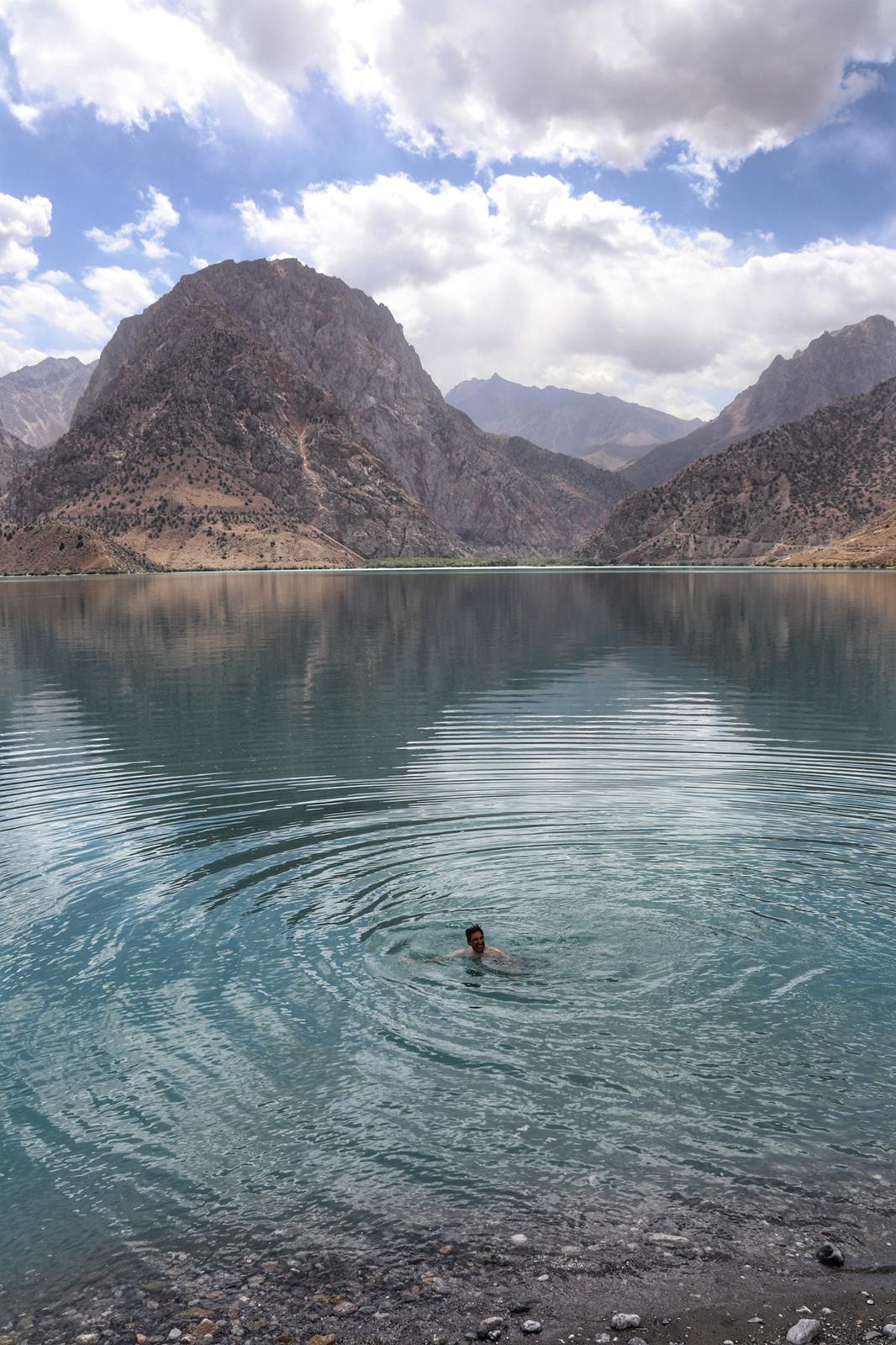
Our lunch stop is at Lake Iskander, named after Alexander the Great,  who apparently came through this area on his way to conquering much beyond.  
Lunch is ordered and the lake looks lovely with towering mountains in the distance, and, well, it would be a shame not to have a dip. And so I did, and bloody cold it was too!
On the return journey we enjoy the sweeping roads and stop to take photos along the way. The overtaking by the locals reminded me of India; Mark ahead of me, overtaking a lorry, was himself overtaken at the same time by particularly gung-ho Audi driver.  

Refuel and return to our Dushanbe hotel, 261km today. (I'm using my Garmin watch to track an 'e-bike' ride! 🤣

I go for a short run before dinner, then enjoy a relatively guilt-free shower as there appears to be no water shortage here. 

The group have a hankering for hummus, so we aim for a Lebanese restaurant. And very good it was too. The food from hereon in will be mostly simple local cuisine, usually lamb.

Day 1. An Introductory Day in Dushanbe

A 11am start, which my phone and watch alarms fought over to see who could get me out of bed. 
After breakfast, we assembled just after lunch time, no lunch, just the time. Off to the centre to see a few cultural sites including the third tallest flagpole in the world, which flies a 30 m × 60 m flag from its 165m height. From a distance the only indication of its size is the perceived speed of the flutter. Its rather like approaching the giant sequoia trees in California, its size only really hits you when you're up close.  
The centre seems fairly quiet, but it is a Saturday, and it is burning hot outside at well over 30C.

We also see the Presidential Palace and the National Museum of Tajikistan, which explores the history of the region.. Biker Dom is not really into cultural excursions, but it was quite interesting, especially the very large relief map of Tajikistan under a glass floor. We could see all the places we plan to visit. 
There's also a peacock model in the park, with the angriest looking peacock you've ever seen. 

Then onto a bazaar, where Christopher manages to buy the foulest tasting sweets ever.  Supposedly melon. Danny and I also sign away our rights and lives (I'm guessing) and buy local SIM cards. 13 euros for 5GB of data valid for a month. 

I finish the afternoon with a run in what I see to be a local bit of green. Turns out to be the Russian Graveyard. Spooky as its now dark...

Saturday, 27 August 2022

Day 0. Arrival in Dushanbe

Uneventful flights via Istanbul (thumbs up to Turkish Airlines) but landing in Dushabe at 03h30 was never going to be easy. Steve and Mark in business class, breeze through immigration waving their passports, while the rest of us, dusting off the chicken feathers, form long queues at the booths and fill-in registration cards. Some time later we eventually get through and collect our luggage; it's arrived too, phew!

We meet Andre our local guide, a short to taxi ride, and we're at our hotel for a few nights.  A few hours sleep, to the tune of a rumbling A/C, and then Charlie, Mark, Christopher, Steve and Danny and new friend, Cary, gather for an awaiting breakfast. It feels quite muggy outside the air-conditioned room, which we expect to transition to cold as we hit the Pamir altitudes later in the trip.


Friday, 26 August 2022

Packing for a new trip

Packing is an art, but I'm no artist, so I just create a checklist, lay it out on a bed, and then throw everything into a bag. Works mostly, but there's usually something I forget. 
Here's the bed mess
And here's it all packed into the bag. 
I'll be wearing my essential gear as I don't want to risk losing it in my checked-in luggage, and as usual I'll be riding to the airport, leaving my bike chained up in the motorcycle parking area. The sound of Squeaky Sidi boots will thus accompany me me for the whole journey.

Sitting waiting for the flight to board, after an aborted 1st attempt, I realised I had forgotten my phone and had to go back home. 🤦‍♂️ Fortunately, I only lost 15 minutes. 

Oh, where is Biker Dom going? Tajikistan, to ride into the Pamir mountains with a subset of that like-minded group of ruffians. 

Tuesday, 23 August 2022

It's been a while....

So, 2019 was a quiet year for Biker Dom, mainly because he bought a house. That and attempting to climb the tallest mountain in Europe, Mt Elbrus at 5642m.  The attempt failed, because of the weather, but the challenge was indeed formidable (and worthy of a post when I can get around it it).

2019 was also the last "normal" year, what followed will be marked forever in human history.  In 2020 the world changed, new words, new phrases and new initialisms became the norm: pandemic, superspreader, social distancing, isolating, lockdown, teleworking, Zoom, flatten the curve, herd immunity, PCR, PPE bleach injections, and of course, COVID-19.

Shops closed, schools closed and borders closed.  But the world didn't stop, it just found new ways to work, entertain and have fun. Biker Dom was no exception, running became an even more important (and permitted) release, and baking the new challenge; sourdough baking to be more precise (another post perhaps?) It turns out that one needs the other, because the delicious bread that followed, and more specifically its calorific burden, desperately needed to be burned off! 

And so it was: bread, begat runs, begat more bread - the balance was mostly kept, +/- a few kg...

As things gradually started to open up, Biker Dom bought his very first off-road bike, a 1991 DR650RSE - the E is very important, denoting a leg saving electric start feature.  Therein followed months of renovation that involved learning new mechanical skills, all resulting in a roadworthy and rejuvenated bike complete with a self-installed knobbly tyres (perhaps the renovation will be detailed in several posts one day).


The Trans European Trail (TET) was beckoning and Biker Dom's first outing was to the Belgian section starting from around Wavre and heading south west.  After about 30 km of tarmac, admittedly through some nice scenery, he gave up. Alas, Belgium has a hate-hate affair with off-road motorcycling, unlike most other parts of the TET, in Belgium off-roading is most banned and the TET is almost exclusively tarmac - so much for the hard work fitting the TKC80 tyres! :-(

But the story does not end there and more is to come...


Sunday, 2 August 2020

Lockdown: Living Life in Dough Motion

Intro

This is a post I started writing during COVID times (around 2020) and never got around to finishing, but I found it lurking among my files and thought it deserved to be aired, even if only to be the unique entry for that crazy year...


A New BikerDom Adventure in the Sticky Stuff

Not mud this time, but flour.  And not just any flour and dough, but sourdough, that creation of artisan bakeries throughout the pretentious world, but pretty much standard fare in France and Belgium where bread is to die for. So here goes – move over BikerDom: BakerDom, coming through! 


The Sourdough Starter 

The heart and soul of any sourdough bread, your sourdough starter is what gives your bread its pep, its oomph, its va va voom, and if you treat it well, you’ll get some joie de vivre in return.  

A basic starter will take about seven days to develop sufficiently to be put to work. If you use the right flour, and rye flour generally works the best, you might be able to cut that to four days.   


So first off, buy your flour, I tried white at first, but wasn’t happy with the results, in the end Skipton Mills Organic Light Rye allowed me to develop a healthily balanced colony of natural yeasts and bacteria to reliably bake decent bread. You can find that in supermarkets in the UK and I’m sure an equivalent is available here in Belgium too, but I wasn’t able to find the right translation on the shelf… 


Sourdough bakers talk about weighing out ingredients when starting off, but when it comes to the starter, I was lazy, I just threw flour and water together into a paste. Only more recently do I understand the need for measurements, it allows you to better gauge the hydration of your sourdough after it’s all mixed, which has a big impact on the finished results.  Back to the paste, and I mixed about 50g grams of the rye flour with enough (filtered or mineral) water make a thickish paste.  Thick enough to feel resistance when stirred, but not thick enough to form peaks – thick paint is Hugh Fearnley-Whittingstall's analogy, see his guide here (https://www.theguardian.com/lifeandstyle/2013/may/10/hugh-fearnley-whittingstall-recipes-sourdough), which was the starter for my own sourdough learning.  That’s it for the first day, you can rest.  Well, I did. 


Next day, or perhaps earlier if your house is on the warm side and your yeastie beasties are eager beavers, add about the same amount of rye flour and water, mix and relax again. There, this is easy, right? 


Next day you might start seeing some bubbles forming; this is good.  Most guides say scoop out half and throw it away, then add more rye flour and water; this is called “feeding”.  Seems like a waste, and it is initially, but in the long run it stops your starter amount growing exponentially.  You can safely compost the discards or make mini pancakes.  The smell will evolve too, maybe unpleasant at first, but don’t let that bother you. 


Next day do the same, more bubbles I suspect, if not don’t worry, you’ll get there in the end; keep going. The smell is also maturing, maybe becoming more pleasant, perhaps fruity like nail polish. 


After about seven days you should now notice that when you feed your starter, after a few hours it will expand and become bubbly – great, you’ve given birth, now give your baby a name; mine is Horace! You’re ready to begin baking… almost. I love him so much, I keep him in the fridge!

Making bread 

Starts the day before you want to bake. Take out your starter and feed it with flour and water. This will wake it up and it will start to ferment. Once it's expanded to double its size or more, it's active.

Your active sourdough starter can then be used instead of yeast in your bread recipes.  Gather your ingredients: good quality strong (high gluten) flour, water, a pinch of salt, and your starter; and it is your starter, unique to you, so in principle the results will be unique to you too.  Starters generally take on the naturally occurring yeasts and bacteria of their locality but each will be subtly different. 

Mix your ingredients in a bowl, but don’t rush it, sourdough is bread making in dough motion…. It's that extra time that gives the yeasts and bacteria in the starter time to work their magic on the flour, all sorts of exotic chemical reactions are taking place right between your fingers as you mix and kneed, and when you sit back with your feet up, the starter continues its job for hours afterward, even working overnight to develop its complex flavours just for your palate.  


After the initial mix, the dough will still feel quite rough and easily separated and will not have a wholeness about it. 


you let the dough relax in its bowl, cover it with a damp cloth and come back to it 30 minutes later.  


Knead some more, but with less vigour, more of a folding technique to fold air into it and just a few folds will do.  Wet hands will help to keep the dough from sticking to your fingers.  


Cover again and keep doing this folding process every 30 minutes or so for two hours. Gradually the dough will become silky and stretch between your fingers, and you’ll see the dough forming strands that will seem to stretch forever towards the end. The dough will begin to hold its shape and feel like ‘a thing’.  


Then leave it, covered and come back in a few hours.  It will have grown as tiny CO2 bubbles form inside the dough. 


Be gentle at this stage, you don’t want to lose those bubbles. Then a few more folds and again leave it.  The trick is not to leave it too long or otherwise the gluten strands will start to breakdown and the dough will collapse and be useless for breadmaking.  Another hour or so and you can start shaping the dough.  


Shaping

Shaping is another art as you cajole your dough into a shape to form a tight skin on its exterior that gives sourdough its unique crust that is full of flavour. Sprinkle flour onto your flat working surface and pour (yes, pour) your dough out of its bowl or container.  Once there, you can fold its exteriors into its centre, all the while the underneath will be developing a taut skin.  A few outside to inside folds and you can then flip it over, now with the skin uppermost. Now you can gently pull it towards you, the lower edge rolling under the mass of the dough which stretches the skin even more.  Then push it away from you turning as you go; the idea is to get a different part of the dough rolling underneath the dough ball the next time you pull it towards you.  This will develop a tight rounded shape with a taut skin. 


Advanced bakers will at this point put the dough (skin side down in a floured bowl) into a refrigerator to retard the fermentation process which adds additional complexity to the flavours.  The development of flavours, sour or otherwise, is an art involving the ingredients, their ratios, the hydration level of the mix, how long its left, the retardation period (which slows some chemical reactions, but not others) and then the baking itself.  Being rigorous about recording what you are doing helps to find what works and how to consistently achieve good results – it is very much a process of trial and error, but the internet is full of ideas about what to try.  But beware it can become all consuming. 


After an hour or so at room temperature the shaped dough will have relaxed so can be shaped again before you put it onto a floured baking tray, or a baking sheet, which helps prevent it sticking to the tray.  Or if it’s had a few hours (or even overnight) in the fridge it can be turned out directly onto the baking tray / baking sheet – the cooled dough will tend to hold its shape better.   


Then dust the dough with flour and then the magic step, a cut through the top of the dough with a very sharp blade (some use a razor blade for this). The idea of this cut is to provide a clean break in the skin through which the expanding dough (remember those CO2 bubbles) can rise unhindered and so rise higher, creating the highly sought after open airy texture of the sourdough “crumb”. 


Baking 

The rise during baking is further assisted by the skin of the dough remaining pliable as long as possible allowing the expanding dough to keep expanding. This is done by keeping a high moisture inside the oven.  Professionals use moisture-controlled ovens, but us amateurs improvise by using a covered container; “Dutch ovens” are typically used. These are large iron pots with lids that seal the dough inside so keeping the moisture locked in.   


The oven is pre-heated along with the Dutch oven container to 240-250C and the shaped dough put inside.  20 minutes should see the dough rise, then the lid of the Dutch oven can be removed.  This is the most eagerly anticipated point as either the dough, now a loaf, will have inflated magnificently or failing that your ego will be deflated like your flat pancake-like and hard, dense loaf. The latter is a real buzz killer.  Often a flat loaf emerges from the oven, and I just want to immediately start making a new mix to get it right. 


But if you are lucky and you’ve got the process right, another 20 minutes or so in the oven, will develop a lovely golden crust on your new pride and joy. 


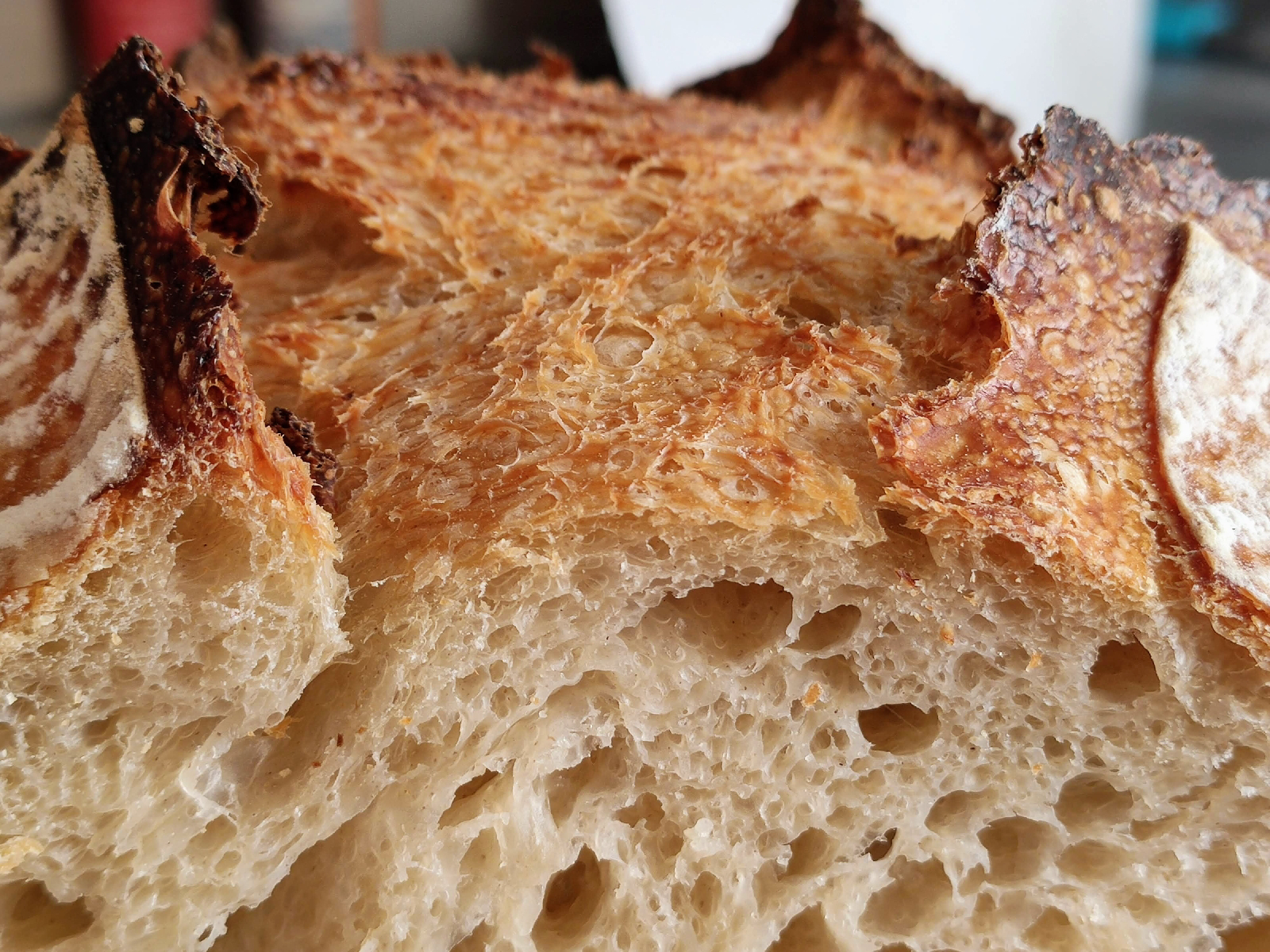
Out of the oven and on a cooling rack and the temptation to cut into it will be very strong, but resist that urge, because it will be a little gooey inside until it has aired for around 30 minutes.  Only then can you cut with confidence and just a little apprehension – are the holes evenly distributed or is there one massive hole inside, another buzz killer.   

Not ideal

Perfect (for me at least)

Eating and Memories

Enjoy the fruits of your labour, spread thick with creamy butter is enough for a tasty treat, but go easy, it’s how I put on a few kilos through COVID, but what enjoyable kilos they were!  

Christmas dinner December 2020


Update 2024: Now out of COVID, I don't have time to bake, but I remember with fondness that new skill I developed when the world was just a little bit crazy.